
David J Knight
David Knight is the founder of the Bible teaching ministry Exposit The Word. Based in the United Kingdom, he is a regular preacher and Bible teacher who hosts a daily Bible study focused on teaching Scripture verse by verse, book by book.
Have you ever found yourself nodding in agreement with something said in church without really understanding what the person was talking about?
What about repeating something simply because you have heard other Christians say it?
Perhaps it was a phrase you began to hear regularly. Week after week, it became more familiar. Then, almost without realising it, the phrase slipped into your everyday vocabulary.
But if someone were to stop and ask, “What do you mean by that?” you might not be entirely sure how to answer, even though you have been using the phrase yourself.
Using language we do not fully understand can have serious consequences, especially when it comes to the things of the Lord. It can lead us to repeat ideas that are unbiblical and spiritually dangerous, both for us and for those who hear them.
If we absorb words and phrases that have been taken out of context or are not biblically accurate, they can distort our understanding of who God is. If such ideas go unchallenged, they may gradually leave us with a caricature of Him. Before we know it, the God we claim to worship may bear more resemblance to one created by our imagination than to the Creator revealed in Scripture.
When Familiarity Replaces Understanding
The way we learn language contributes to the problem. From childhood, we pick up words and phrases by hearing them repeated. Over time, they become part of how we speak, even if we have never carefully considered what they mean.
The same thing happens within Christianity. Those who spend time around Christians, listen to sermons or read Christian books soon become familiar with a particular way of speaking. Certain phrases are repeated regularly, and before long we begin using them ourselves.
This kind of language is known as Christianese.
The problem is not that Christians use particular words and phrases. Many of them can express important biblical truths when properly understood. The problem arises when familiarity replaces understanding. We may know the words without knowing what they mean. We may recognise the phrases, or even particular Bible verses, without stopping to ask whether we are using them correctly and in context.
And that matters because our language both reveals and reinforces what we believe.
When Christian Phrases Distort Biblical Truth
People may be encouraged to “ask Jesus into their heart” without being clearly told about repentance and faith. Christians may introduce their personal thoughts with the words “God told me”, giving those thoughts an authority they do not possess. Churches may use Jesus’ words about two or three gathering in His name to suggest that His presence depends upon a minimum number of believers meeting together, even though those words appear in a passage concerning church discipline. Believers may also be told to “let go and let God”, as though trusting God means becoming passive rather than obeying Him faithfully.
These expressions may be used sincerely, but sincerity does not protect us from error. It is possible to be sincerely wrong.
In addition to this, there can also be an unspoken pressure among Christians to sound as though we understand more than we do. Certain phrases can make us sound confident and spiritually mature, and using them can help us feel that we belong. We may therefore use them, not to mislead others, but to fit in or avoid admitting that we do not understand.
Yet I am sure we would all agree the church is not strengthened by the appearance of knowledge. It is strengthened by a clear and well-grounded understanding of biblical truth.
What Does the Bible Actually Say?
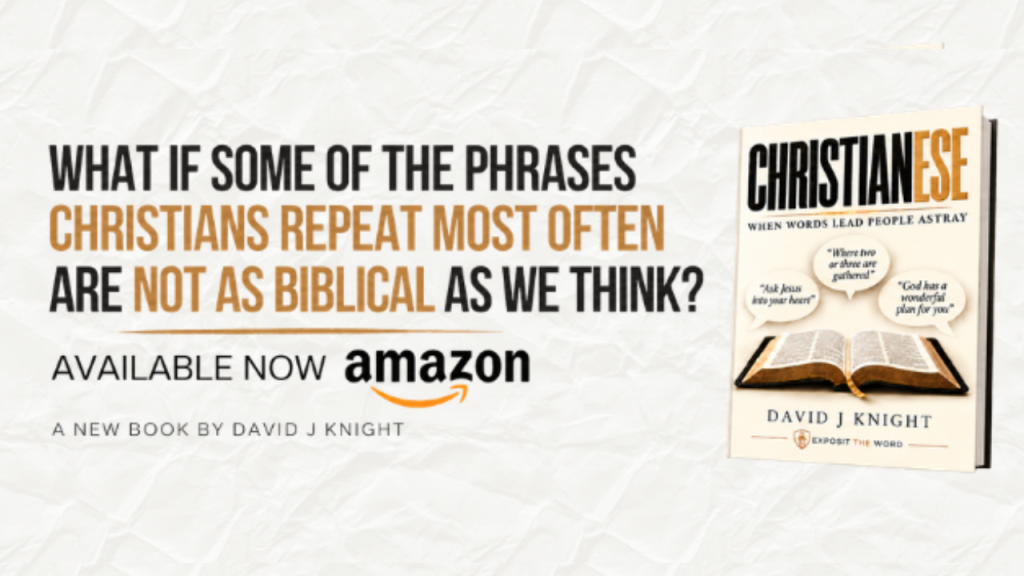
My prayer is that this series, based on my book Christianese: When Words Lead People Astray, will help us examine some of the familiar expressions Christians use, consider what people mean by them and, most importantly, weigh them against Scripture.
The purpose is not to compile a list of expressions that Christians are forbidden to use. Nor is it to encourage us to become suspicious, argumentative or eager to correct everyone around us. It is simply to help us think more carefully, speak more clearly and handle biblical truth more faithfully.
Our understanding of God and His truth must be governed by Scripture. Habit, tradition and personal experience should not be permitted to carry an authority that belongs to the Word of God alone.
The question is not, “What do we mean?”
The question should always be, “What does the Bible say?”
—
Explore the Christianese Series
This is the first article in a new weekly series based on my book, Christianese: When Words Lead People Astray.
Over the coming weeks, we will examine 14 familiar Christian expressions, exploring what people commonly mean by them and considering what Scripture actually teaches.
Next week, we will begin with the expression Ask Jesus into Your Heart”, examining whether this familiar invitation accurately communicates the biblical gospel.
If you would like to explore all 14 expressions now, Christianese: When Words Lead People Astray is available on Amazon in paperback, Kindle and audiobook.
Find out more about the book, read reviews from advance readers or get your copy here: