
George Whitefield (1714-1770)
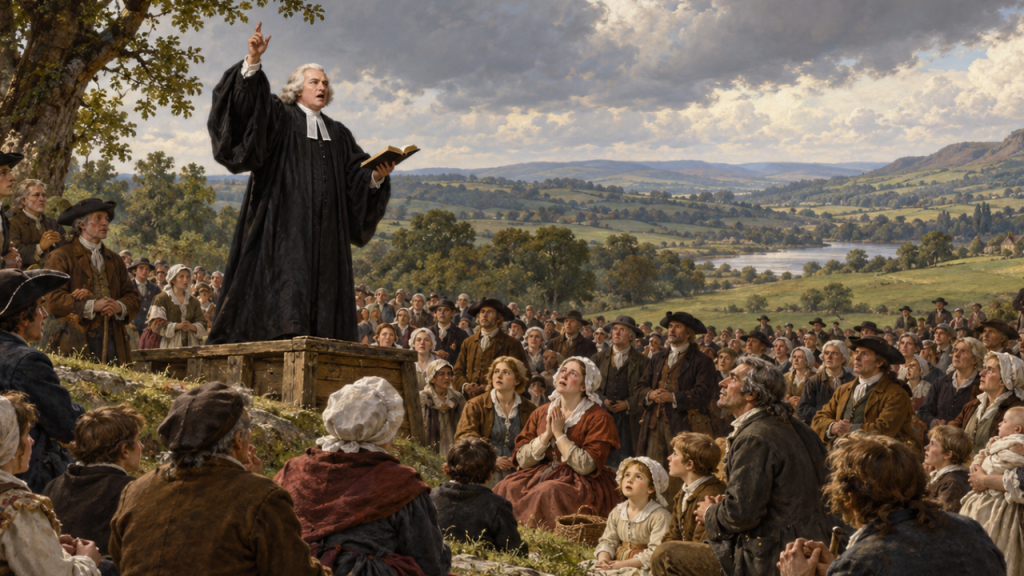
George Whitefield was an English Anglican evangelist and a leading preacher of the eighteenth-century Evangelical Revival. A pioneer of open-air preaching, he proclaimed the gospel to crowds across Britain and America.
Matthew 18:3, “Truly, I say unto you, except you be converted, and become as little children, you shall not enter into the kingdom of Heaven.”
I suppose I may take it for granted that all of you, among whom I am now about to preach the kingdom of God, are fully convinced that it is appointed for everyone to die once, and that you truly believe that after death comes judgement. The consequences of that judgement will be that you must either dwell in the blackness of darkness or ascend to live with the blessed God for ever and ever.
I may also take it for granted that, whatever your conduct in everyday life, there is not one of you—not even the most profligate and abandoned—who does not hope to go to the place Scripture calls heaven when he dies. And, if I know anything of my own heart, my heart’s desire and prayer to God for you all is that I may see you seated in the kingdom of our heavenly Father.
Yet, although we all hope to go to heaven when we die, if we judge by people’s lives—and our Lord says we shall know them by their fruits—I fear we shall find that thousands upon thousands who hope to enter that blessed place after death are not now walking the road that leads there. We call ourselves Christians, and would regard it as an insult if anyone questioned whether we were Christians. Yet many who bear Christ’s name do not even know what real Christianity is.
Ask many people what their hope of heaven rests upon, and they will tell you that they belong to this or that denomination or branch of Christianity, into which Christendom has so sadly been divided. Ask others what foundation they have for their hope, and they will say that they have been baptised, that their fathers and mothers presented them to the Lord Jesus in infancy. Although they have fought against Christ almost ever since their baptism, rather than fought under His banner, they expect us to believe that because they were admitted to church and their names entered in the parish register, their names must also be written in the book of life.
Many will not build their hope of salvation on so poor and rotten a foundation. Yet if they are what we generally call decent people—if they live so that their neighbours cannot say they have harmed anyone—they do not doubt that they will be happy when they die. Indeed, I have seen many such people die, as Scripture says, “without any hands in their death.” If someone is what the world calls an honest, moral person—if he acts justly, shows a little mercy, is sometimes good-natured, gives to the poor, receives the Lord’s Supper once or twice a year, and appears sober and honest—the world regards him as a true Christian. We should, of course, judge charitably of everyone of that sort.
There are also many who go through a regular round of religious duties and performances, thinking that this will take them to heaven. But examine them, and you will find that although they have Christ in their heads, they have no Christ in their hearts.
The Lord Jesus Christ knew this very well. He knew how desperately wicked and deceitful the human heart is. He knew how many would go to hell even by the very gates of heaven; how many would climb right up to the door, come so near as to knock, and yet be sent away with the words, “Truly I do not know you.” The Lord therefore tells us plainly what great change must take place in us, and what must be done for us, before we can have any well-grounded hope of entering heaven’s kingdom.
He tells Nicodemus that unless a person is born again, from above, and born of water and the Spirit, he cannot enter the kingdom of God. Among all our Lord’s solemn declarations on this subject, the words of our text are perhaps among the most solemn: “Unless you are converted and become like children, you will never enter the kingdom of heaven.”
Look at the context: the disciples came to Jesus (v. 1). Whitefield understands that they had already received God’s grace and had faith in Christ, though their faith was still weak. Jesus is not saying that they must be saved again, or that salvation is achieved gradually. Rather, He is confronting their pride and worldly ambition. Though they belonged to His kingdom, sin and self-seeking remained in them. They needed to become more childlike in humility, and to grow in holiness, so that their lives would increasingly show that they belonged to Him. His kingdom would not be an earthly realm of status, as they imagined, but a spiritual kingdom begun here and brought to completion in the age to come.
The kingdom they belonged to was not to be established in outward splendour, as they imagined. It was a spiritual kingdom, begun here and completed in the kingdom of God to come.
Although the words have a particular reference to the disciples, our Lord makes a similar declaration elsewhere in Scripture, especially in His conversation with Nicodemus. I believe, therefore, that we may rightly apply them to both saints and sinners. I suppose there are two kinds of people here: some who know Christ and some who do not; some who are converted and some who remain strangers to conversion. I shall try to speak in such a way that, if God is pleased to help me and give you ears to hear and obedient hearts, both saints and sinners may receive their portion.
First, I shall try to show what our Lord means when He says that we must be converted and become like little children. Secondly, I shall speak to those who show something of this childlike spirit. Lastly, I shall speak to those who have no reason to think that this change has ever taken place in their souls.
1. What it means to be converted and become like little children
Before I come to the main point, I should make one or two things clear.
First, the words plainly teach that before you or I can have any well-grounded, scriptural hope of being happy in the life to come, a great, remarkable and astonishing change must take place in our souls.
I believe every adult in this congregation will readily admit that a great change has taken place in our bodies since we first came into the world as infants, dandled on our mothers’ knees. It is true that we have no more limbs than we had then, but how they have changed! In one respect we are the same, in the number of our limbs and the general shape of our bodies. Yet if someone who knew you as a baby had been away for years and then saw you as an adult, the chances are a thousand to one that he would not recognise you. You are so changed, so different from the little child you once were.
The words plainly imply that a great change has taken place in our bodies since childhood. In the same way, before we can go to heaven, as great a change must take place in our souls. Our souls remain the same in their essential being; no philosophical change is made to them. But in our disposition, habits and conduct we must be so changed that those who knew us recently in a state of sin, before we knew Christ, will be astonished by the difference—just as someone might be astonished to see a person after twenty years away, having last known him as an infant.
Children are not sinless
Secondly, I think it necessary to say something more, because this text is a stronghold for Arminians and others. They have learned from the devil to use texts in support of bad principles. When the devil wanted to tempt Jesus Christ, he quoted Scripture because Christ had quoted Scripture. In the same way, people who want their doctrine and false principles to be more readily accepted would persuade unwary and unstable souls that their teaching is founded on God’s Word.
The doctrine of original sin is written so plainly in Scripture that anyone who runs may read it. Everything outside us and everything within us clearly proclaims that we are fallen creatures. Even the heathen, who had only the dim light of unaided reason, complained of this. They felt the wound and recognised the disease, but did not know its cause. Yet too many who have been baptised in the name of Christ dare to speak against original sin and are angry with ministers who paint humanity in such dark colours.
They say, “It cannot be that children come into the world with the guilt of Adam’s sin resting on them.” Ask them to prove this from Scripture, and they appeal to our text: “Unless you are converted and become like children, you will never enter the kingdom of heaven.” Their argument goes like this: “The words imply that little children are innocent, that they come into the world like a blank sheet of white paper. Otherwise our Lord would be arguing absurdly: He could not say that we must be converted and made like wicked creatures. That would not be conversion.”
My dear friends, this makes Jesus Christ say what He never intended and what cannot be drawn from His words. That little children are guilty—that they are conceived and born in sin—is clear from the whole teaching of God’s Word. David was a man after God’s own heart, yet he says, “Behold, I was brought forth in iniquity, and in sin my mother conceived me” (Ps. 51:5). Jeremiah, speaking of the human heart, says, “The heart is more deceitful than all else and is desperately sick” (Jer. 17:9). God’s servants declare with one voice—and Paul quotes one of them—that we have all turned aside, become altogether worthless, and that no one does good, not even one (Rom. 3:10–12).
I appeal to you mothers and fathers: do you not see original sin and corruption in your children from the moment they come into the world? As they grow, do you not discover self-will and an aversion to what is good? Why are your children so resistant to instruction, except that they bring into the world hostility towards a good and gracious God?
Sickness and death came into the world through sin, and it does not seem consistent with God’s goodness and justice that a little child should suffer sickness or death unless Adam’s first sin were imputed to him. If anyone accuses God of injustice for imputing Adam’s sin to a little child, remember that we have a second Adam to bring our children to.
So when our Lord says, “Unless you are converted and become like children,” we must not understand Him to be suggesting that little children are perfectly innocent. Rather, He speaks comparatively and, as I shall show shortly, in a particular respect. Compare little children with grown people and they appear innocent; consider them as they are in themselves, as they come into the world, and they have sensual hearts and carnal minds.
I mention this with deep concern because I truly believe that unless parents are convinced of this, they will never take proper care over their children’s upbringing. If parents understood how bad their children’s hearts are, they would not be eager to let them go to balls, assemblies and plays, whose natural tendency is to corrupt their minds and make them children of the devil. If parents were convinced of this, I believe they would pray more when they bring their children for baptism and would not treat it as a mere formality. If they were truly convinced that their children were conceived in sin, they would always offer the prayer I have heard a good woman offer before her children were born: “Lord Jesus, let me never bear a child for hell or the devil.”
Oh, is it not to be feared that thousands of children will stand before God on the great day and say in the presence of angels and people, “Father and mother, after the wickedness of my own heart, I owe my damnation to your poor upbringing of me”?
Having made these two points, I now come to what we really mean when we say that we must be converted and become like little children.
Humility rather than worldly ambition
The Evangelist tells us that the disciples came to Jesus at this time and asked, “Who then is greatest in the kingdom of heaven?” They had taken up the prevailing idea that the Lord Jesus Christ was to be an earthly prince. They dreamed of being ministers of state, sitting at Christ’s right hand in His kingdom and ruling over God’s people. They thought themselves qualified for high office, as ignorant people are often apt to do.
“Who is greatest in the kingdom of heaven?” they ask. “Which of us will manage public affairs?” What a question for a few poor fishermen who scarcely knew how to drag their nets to shore, let alone govern a kingdom!
Our Lord therefore calls a little child in verse 2 and places him among them to humble them. His action was as if He had said, “Poor creatures! Your ambitions are soaring. You are arguing about who will be greatest in the kingdom of heaven. I shall let this little child preach to you—or I shall preach to you through him. Truly I say to you—I who am Truth itself and know how My subjects must enter My kingdom—you are so far from having the right spirit for My kingdom that unless you are converted and become like this little child, you will never enter it. Unless, speaking comparatively, you are as detached from the world, from crowns, sceptres, kingdoms and earthly things as this little child in My arms, you will not enter My kingdom.”
Our Lord is not speaking about the innocence of little children, considered in their relationship to God or as they are in themselves when they are born. He means that, as regards ambition and desire for the world, we must become like little children.
Is there a little boy or girl in this congregation? Ask a small child who can just speak about a crown, sceptre or kingdom: the child has no idea what these things mean. Give a little boy or girl some small toy to play with, and the child will leave the world to other people. In this sense we must be converted and become like little children: we must, comparatively speaking, be detached from the world.
Do not misunderstand me. I am not going to persuade you to close your shops or give up your work. I am not going to tell you that to be Christians you must become hermits and leave your children to be provided for by miracles. You cannot leave your wicked heart behind when you leave the world. I have found that when I am alone, my wicked heart follows me wherever I go. No, the religion of Jesus is a social religion.
Jesus Christ does not call us to leave the world, shut up our shops and expect our children to be fed by miracles. Yet this must be said to the honour of Christianity: if we are truly converted, we shall be detached from the world. Although we are engaged in it and must work for our children; although we must follow trades and commerce and serve the common good, if we are real Christians we shall not be bound to the world. I do not claim that all real Christians have reached the same degree of spiritual-mindedness. This is the primary meaning of our Lord’s words: we must be converted and become like little children. But I believe the words carry other meanings as well.
Dependence, teachability and simplicity
When our Lord says that we must be converted and become like little children, I believe He also means that we must recognise our weakness, as a little child does. Everyone regards a little child as weak, as someone who must go to school and learn something new each day, and as simple and open—someone who has not yet learned the hateful art of pretending.
I believe we are to understand the text in all these ways. Are little children aware of their weakness? Must they be led by the hand? Must we hold them, or they will fall? In the same way, if we are converted and God’s grace is truly in our hearts, my dear friends, whatever we once thought of ourselves, however lofty our former opinion of ourselves may have been, we shall now recognise our weakness. We will no longer say, “I am rich and have become wealthy and have need of nothing.” We shall know ourselves to be poor within and feel that we are wretched, miserable, poor, blind and naked (Rev. 3:17).
As a little child gives its hand to be guided by a parent or nurse, so those who are truly converted and are real Christians will give their hearts, understanding, wills and affections to be guided by the Word, providence and Spirit of the Lord. That is why the Apostle says of God’s children, “For all who are being led by the Spirit of God, these are sons of God” (Rom. 8:14).
Little children also know that they are ignorant. Those who are converted recognise their own ignorance too. That is why John calls Christians “little children”: “I am writing to you, little children” (1 John 2:12). Christ’s flock is called a little flock, not only because it is small in number, but also because those who belong to it are truly little in their own eyes.
That great man, the great Apostle to the Gentiles and spiritual father of so many thousands of souls—one who, in Dr Goodwin’s opinion, “fits nearest the God-man, the Lord Jesus Christ, in glory”—that chosen vessel, the Apostle Paul, speaks of himself as “the very least of all saints” and says that grace was given to him to preach among the Gentiles the unfathomable riches of Christ (Eph. 3:8).
Some of you may think, when you read these words, that Paul was not speaking truthfully, that he did not really feel what he said. You judge Paul’s heart by your own proud hearts. But the more you receive God’s grace and share in the divine life, the more you will see your own baseness and vileness, and the smaller you will become in your own eyes.
Mr Flavel, in his book Husbandry Spiritualized, compares young Christians to green corn. Before it ripens, it shoots up very high, but has little substance. An older Christian is like ripe corn: it does not hold its head so high, but it is heavier and ready to be cut down and gathered into the farmer’s barn. Young Christians are also like little streams. They are shallow, yet make a great noise. An older Christian makes less noise and moves on gently, like a deep river flowing into the ocean.
A little child is also regarded as harmless and generally speaks the truth. If we are converted and become like little children, we shall be free from deceit as well as harmless. What did our dear Redeemer say when He saw Nathanael? It was as if He had found a rare sight and wanted others to look at it too: “Behold, an Israelite indeed, in whom is no deceit!” (John 1:47).
Do not misunderstand me. I am not saying that Christians should be imprudent. They ought earnestly to ask God for prudence. Without it, they may follow the devil’s delusions and, through carelessness, mishandle the ark of God. A great man once lamented, “God has given me many gifts, but God has not given me prudence.”
When I say that a Christian must be guileless, I do not mean that he should expose himself to every attack. We should ask for the wisdom of the serpent, although we generally learn this wisdom through our mistakes and lack of prudence. We must make some progress in Christianity before we understand how imprudent we are.
A person who is truly converted can say, as it is reported of a philosopher, “I wish there were a window in my breast so that everyone could see the integrity of my heart and intentions.” The old self remains too much in us, but if we are truly converted there will be no deceit that we deliberately tolerate. We shall be harmless. This is why the poor Christian is so often taken advantage of: he judges others by himself. Because he has an honest heart, he thinks everyone else is as honest as he is and becomes easy prey. I could say much more about each of these points; the truth is rich and important. But I do not intend to multiply marks and headings.
2. A word of application to those who show this childlike spirit
I have something to say by way of personal application. So, with the greatest tenderness and at the same time with faithfulness, let me call on you, my dear friends.
My text is introduced solemnly: “Truly I say to you.” What Jesus said then, He says now to you and to me, to all who sit under the preaching of the gospel, and to all whom the Lord our God will call. Let me urge you to examine whether you are converted, whether such a great and mighty change has taken place in your soul.
As I told you before, you all hope to go to heaven, and I pray Almighty God that you may all be there. When I see a congregation like this, if my heart is in a right state, I feel ready to lay down my life if only I might be used to save one soul. My heart bleeds within me. At times it makes me almost unwilling to preach, for fear that the word I hope will do good may, through people’s own unbelief, increase the condemnation of some—perhaps of many—who hear it.
Allow me to deal faithfully with your souls. I have your death warrant in my hand: Christ has said it, and Jesus will stand by it. It is like the law of the Medes and Persians; it cannot be changed. Listen, man! Listen, woman! Whoever has ears to hear, let him hear what the Lord Jesus Christ says: “Truly I say to you, unless you are converted and become like children, you will never enter the kingdom of heaven.”
It is Saturday night, and you are preparing for the local church. Yet you may not live to see it. You have had dreadful reminders of this lately. A woman died only yesterday; a man died the day before; another person was killed by something that fell from a house. In another twenty-four hours, many of you may have entered an unchangeable state.
For God’s sake, and for the sake of your own souls, if you want to live with God and cannot bear the thought of dwelling in everlasting fire, silently offer this prayer before I go any further—or say Amen to the prayer I would put in your mouths: “Lord, search me and know me; examine my heart and let my conscience speak. Oh, let me know whether I am converted or not!”
What do you say, my dear hearers? What do you say, fellow sinners? What do you say, my guilty brothers and sisters? Has God, by His blessed Spirit, worked such a change in your hearts? I am not asking whether God has made you angels. That will never happen. I am asking whether you have any well-grounded hope that God has made you new creatures in Christ Jesus, and so renewed and changed your nature that you can say:
“I humbly hope that the habitual disposition and direction of my mind are now free from wickedness. I have a husband or wife; I have children; I keep a shop and attend to my work. But I love these things for God’s sake and do everything for Christ. If God were to call me away now, I could say, as the settled disposition of my heart, ‘Lord, I am ready.’ However much I love the things God has given me, I hope I can also say, ‘Whom have I in heaven but You? And besides You, I desire nothing on earth’ (Ps. 73:25). Can you thank God for His gifts and say at the same time, ‘These are not my Christ’?”
I speak plainly; you know my way of preaching. I do not want to play the orator or be counted a scholar. I want to speak in a way that reaches the hearts of ordinary people.
What do you say, my dear hearers? Do you recognise your weakness? Do you feel that by nature you are poor, miserable, blind and naked? Do you give your hearts, affections, wills and understanding to be guided by God’s Spirit, as a little child gives its hand to be led by its parent? Are you small in your own eyes? Do you think humbly of yourselves? Do you want to learn something new every day?
I mention these signs because I think they may be better suited to many of your understanding. Many of you no longer have the feelings you once had. As a result, you are ready to give up all your evidences of grace and make room for the devil to enter your heart. You are not carried up the mountain as you once were, so you conclude that you have no grace at all. But if the Lord Jesus Christ has emptied and humbled you, if He is teaching you to see and know that you are nothing, then although you are not growing upwards, you are growing downwards. Although you do not have so much joy, your heart is being emptied so that it may be filled more fully in due time. Can any of you follow what I am saying? Then thank God and take comfort from it.
If you are converted and have become like a little child, I welcome you, in the name of the Lord Jesus, into God’s dear family. In the name of our dear Redeemer, I welcome you into the company of God’s children. Dear souls, although the world sees nothing in you and there may be no outward difference between you and others, I see you in another light: as sons and daughters of the King of kings. All hail! In God’s name, from my heart I wish joy to every one of you, sons and daughters of the King of kings.
Will you not from now on live with a childlike spirit? Will this thought not melt your hearts? The great God could have frowned upon you and sent you to hell for secret sins known only to God and your own souls. He could have condemned you time after time. Instead, He has covered you with the cloak of His love. His voice has said, “Let this man, let this woman live, for I have found a ransom.”
Oh, will you not cry out, “Why me, Lord?” If King George were to send for one of your children and you heard that he would adopt him as his son, how greatly honoured you would consider that child! What condescension it was for Pharaoh’s daughter to take Moses, a poor child exposed in a basket of bulrushes, and bring him up as her own. Yet what is that happiness compared with yours? The other day you were a child of the devil; now, through converting grace, you have become a child of God.
Are you converted? Have you become like little children? Then what should you do? My dear hearers, obey God. Remember that God is your Father. You all know what a dreadful burden it is to have a wicked, disobedient child. If you do not want your own children to disobey you, then for Christ’s sake do not disobey your heavenly Father.
If God is your Father, obey Him and serve Him. Love Him with all your heart, all your might, all your soul and all your strength. If God is your Father, flee from everything that displeases Him, and walk worthy of the God who has called you to His kingdom and glory.
If you are converted and have become like little children, behave like children. They long for milk and are content with it. If you are newborn babies, long for the pure milk of the word, so that by it you may grow (1 Pet. 2:2). I do not want Arminian husks to satisfy you. You are sons and daughters of the King, and you have a more refined taste. You must have the doctrines of grace. Thank God that you live in a country where the pure Word is preached so plainly.
Are you children? Then grow in grace and in the knowledge of our Lord and Saviour Jesus Christ (2 Pet. 3:18). Do you have children who do not grow? Do you not grieve over them and cry for them? Do you not say, “My child will never be fit for anything in the world”? If it grieves you to see a child fail to grow, how much more must it grieve Christ’s heart to see you grow so little?
Will you always remain children? Will you always be learning the first principles of Christianity and never press on towards the goal for the prize of the upward call of God in Christ Jesus (Phil. 3:14)? God forbid. Let this be the language of your hearts: “Lord Jesus, help me to grow; help me to learn more; teach me to live so that everyone can see my progress.”
Are you God’s children? Are you converted and become like little children? Then deal with God as your own little children deal with you. As soon as they want something, or someone hurts them, they run straight to their parent. I appeal to you: is that not what they do? Well, are you God’s children? Does the devil trouble you? Does the world trouble you? Go and tell your Father about it. Go at once and complain to God.
Perhaps you say, “I cannot put it into fine words.” But do you expect fine words from your children? If they come crying and can manage only half-formed words, does your heart not yearn for them? Does God not have infinitely greater compassion for you? Even if you can only make signs to Him, “As a father pities his children, so Yahweh pities those who fear Him” (Ps. 103:13).
So I urge you to be bold with your Father, saying, “Abba! Father!” Tell Him, “Satan troubles me; the world troubles me; my own family are angry with me. Heavenly Father, plead my cause!” The Lord will speak for you in one way or another.
Are you converted and become like little children? Have you entered God’s family? Then be sure that your heavenly Father will discipline you from time to time: “For what son is there whom his father does not discipline? But if you are without discipline, of which all have become partakers, then you are illegitimate children and not sons” (Heb. 12:7–8).
It is recorded of Bishop Latimer that, when he was staying in a house, he overheard the master say, “I thank God I have never had a cross in my life.” “Ah,” said Latimer, “then I will not stay here.”
I believe every child of God, when in a good frame of heart, has prayed for great humility, great faith, great love and every grace of the Spirit. Do you know that when you offered these prayers you were also asking, “Lord, send us great trials”? How else can you know whether you have great faith, humility and love unless God puts you through great trials, so that you may discover whether these graces are really in you?
I say this because many of God’s children—I know it has often been a temptation to me when I have been under God’s sharp rod—think, when they face great trials, that God is giving them up. So if you are God’s children, if you are converted and have become like little children, do not expect God to be a foolish parent. He is a jealous God. He loves His child too much to spare the rod.
How did He discipline Miriam? How did He discipline Moses? How has God disciplined His dearest children in every age? So if you are converted and become like little children, and God has taken away a child or your possessions, or allowed friends to forsake you, so that you seem abandoned by both God and people, say, “Lord, I thank You. I must be a wayward child, or You would not strike me so often and so hard.”
Do not blame your heavenly Father; blame yourselves. He is a loving God and a tender Father. “In all their affliction He was afflicted” (Isa. 63:9). When God spoke to Moses from the bush, it was as if He said, “Moses, this bush represents My people. As this bush burns with fire, so My children must burn with affliction. But I am in the bush. If the bush burns, I will burn with it. I will be with them in the furnace and with them in the water. Even when the water comes over them, it will not overflow them” (see Isa. 43:2).
Are you God’s children? Are you converted and become like little children? Then will you not long to go home and see your Father? Happy are those who have reached home before you; happy are those who are up there, who have risen above this field of conflict. I do not know what you may think of it, but since I heard that some whose hearts God had been pleased to work upon have gone to glory, I am sometimes filled with grief that God is not pleased to let me go home too.
How can you see such coldness among God’s people? How can you see them waxing and waning like the moon? Who could help longing to be with the Lord for ever? Thanks be to God, the time is coming soon. Thanks be to God, He will come and will not delay. Do not be impatient: God will bring you home in His own time.
Although you may have little to live on now, and some of you may be in straitened circumstances, do not grumble. God, together with the gospel of Christ and brown bread, is great riches. In your Father’s house there is bread enough and to spare. Although you are tormented now, you will soon be comforted. The angels will consider it an honour to carry you to Abraham’s side, even if you are only a Lazarus here. My heart is inclined to speak words of comfort to God’s people.
There is only one more thing I shall mention. If you are converted and have become like little children, for God’s sake take care not to do what children often do: quarrel with one another. Oh, love one another. “The one who abides in love abides in God, and God abides in him” (1 John 4:16).
Joseph knew his brothers might quarrel, so when he left them he said, “Do not quarrel on the journey” (Gen. 45:24). You are all children of the same Father, and you are all going to the same place. Why should you fall out? The world has enough against us, and the devil has enough against us, without our quarrelling with one another. Oh, walk in love.
If I could preach no longer, if I could not carry on to the end of my sermon, I would say, as John did when he was old and unable to preach, “Little children, love one another.” If you are God’s children, love one another. Nothing grieves me more than the divisions among God’s people. Oh, hasten the day when we shall either go to heaven or never quarrel again!
3. A word to those who are not converted
Would to God I could speak to all of you in this comforting way. But my Master tells me, “Do not give what is holy to dogs, and do not throw your pearls before swine” (Matt. 7:6). So although I have been speaking comfortingly, what I have said—especially in the latter part of this sermon—belongs to God’s children. It is the children’s bread.
If any of you are graceless, without Christ and unconverted, I charge you not to touch it. I set a boundary around it in God’s name. Here is a flaming sword, turning in every direction, to keep you from this bread of life until you turn to Jesus Christ.
I suppose many of you are unconverted and graceless. So go home, go to your private room and humble your stubborn heart before God. If you have not done this before, let tonight be the night. Or do not wait until you get home. Begin now, while you are standing here. Pray to God, and let this be the cry of your heart: “Lord, convert me! Lord, make me a little child! Lord Jesus, do not banish me from Your kingdom!”
My dear friends, the words mean more than they say explicitly. When Christ says, “You will never enter the kingdom of heaven,” He is also saying, “You will certainly go to hell. You will certainly be condemned and dwell for ever in the blackness of darkness. You will go where the worm does not die and the fire is not quenched.”
May the Lord God impress this on your souls! May an arrow dipped in the blood of Christ—as someone recently wrote to me in a letter—reach the heart of every unconverted sinner! May God fulfil the text in every one of your souls! He alone can do it.
If you confess your sins, leave them and lay hold of the Lord Jesus Christ, the Spirit of God will be given to you. If you go and say, “Turn me, O my God,” you do not know what answer God may give you.
If I thought that preaching could accomplish it, if I thought arguments would persuade you to come, I would carry on speaking until midnight. And although some of you may hate me without cause, I wish every person in this congregation were as deeply concerned for himself as I now feel, by God’s grace, for him.
Oh, that my head were waters and my eyes a fountain of tears, so that I might weep over an unconverted, graceless, wicked and adulterous generation! Precious souls, for God’s sake consider what will become of you when you die if you die without being converted. If you leave this life without the wedding garment, God will strike you speechless and banish you from His presence for ever and ever.
I know you cannot endure everlasting fire. So look: I am showing you a way of escape. Jesus is the way, Jesus is the truth; the Lord Jesus Christ is the resurrection and the life (John 14:6; 11:25). His Spirit must convert you. Come to Christ, and you will receive Him.
May God, for Christ’s sake, give this to you all and convert you, so that we may all meet in His heavenly kingdom, never to part again. Even so, Lord Jesus. Amen and amen.
Has this article encouraged or helped you?
Exposit the Word is a reader-supported ministry dedicated to proclaiming God’s Word faithfully and freely. If you have been blessed by this ministry and would like to help us continue producing biblical resources, please consider supporting us here.