

David J Knight
David Knight is the founder of the Bible teaching ministry Exposit The Word. Based in the United Kingdom, he is a regular preacher and Bible teacher who hosts a daily Bible study focused on teaching Scripture verse by verse, book by book.
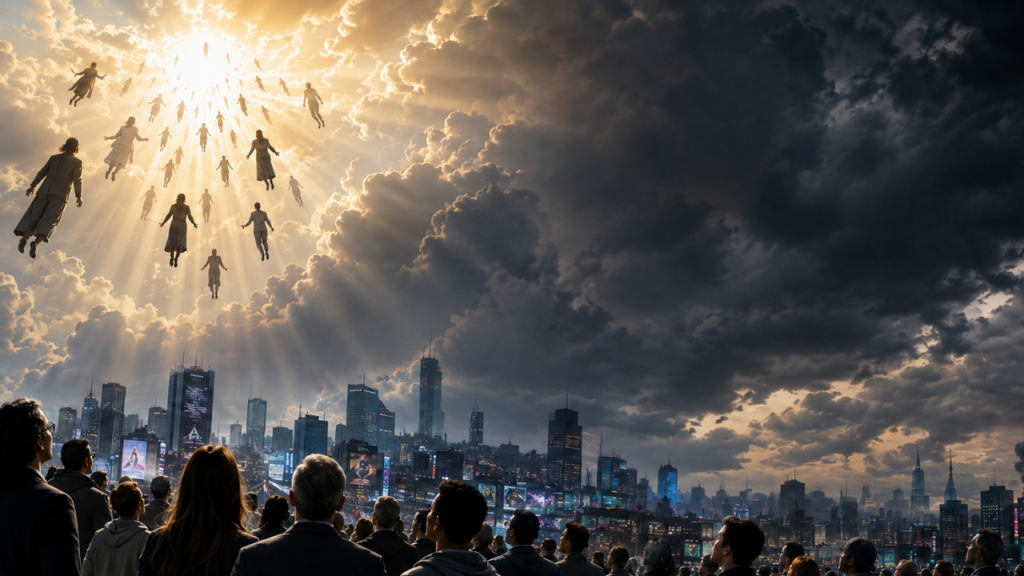
We have all seen the films portraying the Rapture, when in an instant millions of people disappear from the earth in the blink of an eye.
The world is brought to a sudden standstill. Families desperately search for loved ones. Governments demand answers. News organisations are consumed with one question: Where did all these people go? For days, perhaps weeks, the attention of the entire world is fixed upon an event no one can explain.
But what if it does not happen that way?
What if far fewer people disappear than many Christians have imagined because the visible church is much larger than the true Church?
What if Christendom barely flinches? Church buildings open the following Sunday, pulpits are still occupied, congregations are still gathering, and millions of people who called themselves Christians remain on the earth.
Before the world has even begun to understand what has happened, evil could explode, lawlessness increase, society be shaken, deception spread, and the terrible events of the Tribulation begin to unfold.
Perhaps concern over the disappearance of born-again believers would quickly fade as the world comes to terms with escalating evil on a scale it has never experienced before.
Imagine events unfolding so quickly that the disappearance of Christians is already yesterday’s news. The attention of the world’s media has moved on to the unfolding consequences of one crisis after another: social collapse, rioting, unprecedented violence, impending famine, governments falling, and natural disasters occurring around the world. News organisations struggle to keep pace with disasters unfolding locally, let alone globally. In a world increasingly consumed by fear, grief and survival, who will still be thinking about those missing Christians?
It is a sobering possibility.
Scripture does not tell us how the governments of the world will explain the Rapture. It does not tell us what the headlines will say the following morning, how long people will search for those who have disappeared, or what explanations will eventually be accepted.
What Scripture does tell us is that Christ is coming for His Church.
Paul writes that “For the Lord Himself will descend from heaven with a shout, with the voice of the archangel and with the trumpet of God, and the dead in Christ will rise first. Then we who are alive and remain will be caught up together with them in the clouds to meet the Lord in the air, and so we shall always be with the Lord.” (1 Thess. 4:16–17). Elsewhere, he describes the transformation of believers as taking place “in a moment, in the twinkling of an eye” (1 Cor. 15:52).
For the true believer, this is not something to fear. It is our blessed hope. Christ will gather His people to Himself, and we will be with Him before the great Tribulation unfolds upon the earth.
Yet when we consider what Scripture also says about the spiritual condition of the last days, the rise of lawlessness, the removal of restraint and the extraordinary deception that will characterise the period that follows, it is a thought worth pondering.
What if the world barely has time to notice?
The Church the World Sees
When we think about the Rapture, it is easy to see why many Christians have imagined that an enormous number of people will suddenly disappear. Christianity is the largest religion in the world, and vast numbers of people identify themselves as Christians. Yet there is an important distinction that Scripture repeatedly places before us: the visible church and the true Church are not necessarily the same thing.
Not everyone who calls himself or herself a Christian belongs to Christ.
Jesus gave one of the most solemn warnings in the New Testament when He said, “Not everyone who says to Me, ‘Lord, Lord,’ will enter the kingdom of heaven” (Matt. 7:21). These are people who profess His name. They recognise Him as Lord and apparently expect to be received by Him, yet their profession is not evidence that they truly belong to Him.
There have always been those who outwardly identify with Christianity without being born again and therefore without actually being Christians. A person may attend church, know Christian language, understand Christian doctrine and even occupy a position of Christian leadership while remaining a stranger to the new birth. None of these things, however valuable in their proper place, can substitute for being reconciled to God through Jesus Christ.
Scripture also warns us that the latter days will be marked by spiritual departure. Paul writes that “in later times some will fall away from the faith” (1 Tim. 4:1), and in describing the difficult times of the last days he speaks of people “holding to a form of godliness, but having denied its power” (2 Tim. 3:5).
This is not the disappearance of religion. If anything, it is the proliferation of counterfeit religion. The outward form remains while the inward substance is absent.
We should not go beyond what Scripture reveals. The Bible does not tell us how many genuine believers will be alive when Christ comes for His Church, and there is no biblical basis for calculating whether the number will be comparatively large or small. Yet neither should we assume that everyone who presently bears the name Christian belongs to Christ.
That raises a sobering possibility.
What If Much of “Christianity” Remains?
If Christ gathers His true Church to Himself, the removal of believers would not necessarily mean the disappearance of everything the world presently recognises as Christianity.
Church buildings would remain. Denominations and religious institutions could remain. Christian books would still sit on shelves, sermons would remain online, and Bibles would still be found in homes throughout the world. Depending upon the spiritual condition of the visible church at that time, there could even be congregations continuing to meet and people continuing to preach from Christian pulpits.
If this is so, we can imagine the enormous confusion that could follow the Rapture. If people who identified themselves as Christians remained, the world might conclude that whatever had happened could not possibly have been the event Christians had spoken about. Religious leaders themselves might offer explanations for the disappearances while failing to understand why others had been taken and they had remained.
It is a disturbing thought, but it exposes something that is already true today. Human beings see church membership, religious activity and outward profession. Christ knows those who are His.
Perhaps, then, the greatest shock after the Rapture will not simply be who has disappeared.
It may be who has not.
In a single moment, the distinction between professing Christ and possessing Christ could be exposed in a way that had previously been hidden from human sight.
When the Restraint Is Removed
There is another aspect of the biblical picture that deserves careful consideration. In 2 Thess. 2, Paul speaks of a restraining influence presently holding back the revelation of the man of lawlessness:
“And you know what restrains him now, so that in his time he will be revealed. For the mystery of lawlessness is already at work; only he who now restrains will do so until he is taken out of the way.” (2 Thess. 2:6–7)
As we know, the Holy Spirit dwells within every born-again believer. Within a pre-tribulation understanding of this passage, many have identified the restrainer with the Holy Spirit exercising His restraining ministry through the Church. If this interpretation is correct, then when the Church is removed at the Rapture, that particular restraint upon lawlessness will also be removed.
We already live in a fallen world. Wickedness surrounds us, and the mystery of lawlessness, as Paul says, is already at work. Yet if there is presently a divine restraint upon the full expression of that lawlessness, we have never experienced the world as it will be when that restraint is removed.
This may help us understand why events following the removal of the Church could unfold with extraordinary speed.
A World Overwhelmed
The immediate consequences of a sudden disappearance could produce tremendous grief and confusion. Families would be divided without warning. Responsibilities would suddenly be abandoned. People would be searching for husbands, wives, parents, children and friends. Depending upon the number and circumstances of those taken, disruption could spread into many areas of ordinary life.
But what if these things were quickly followed by something worse?
Jesus spoke of a coming period of “For then there will be a great tribulation, such as has not occurred since the beginning of the world until now, nor ever will. (Matt. 24:21). Revelation portrays war, famine, death, persecution and divine judgement on a scale that is difficult for us to comprehend.
A man whose Christian wife has disappeared may initially think of little else. He may search for her, grieve for her and remember everything she told him about Christ. But if the world around him begins descending into chaos, his immediate concerns may rapidly become more basic. How will he feed his family? Is he safe? What is happening to his country? What will happen tomorrow?
This is necessarily speculation, and we must keep it in that category. Yet it is not difficult to understand how one overwhelming crisis can be displaced in the human mind by another still greater crisis. If the Tribulation begins to unfold with the severity Scripture describes, the world’s attention may move very quickly from asking what happened to the missing people to asking how the living are going to survive.
And this brings us to my next consideration. Such a world would also be desperately searching for answers, stability and leadership.
Like someone drowning at sea, people would be desperate to grasp anything that promised safety and security.
Deception in a Frightened World
This may provide part of the background against which the man of lawlessness rises to prominence. Scripture does not give us every political step by which his authority will be established, so again we must resist filling in details God has chosen not to reveal. What Scripture does tell us is that his coming will be accompanied by extraordinary satanic deception.
Paul writes that his coming is “whose coming is in accord with the working of Satan, with all power and signs and false wonders,” (2 Thess. 2:9).
This is important because we can easily assume that witnessing the Rapture would settle the question of Christianity once and for all. Surely, we might think, if believers suddenly disappeared exactly as Christians had said they would, everyone left behind would recognise that the Bible was true.
Scripture gives us little reason for such confidence in the human heart.
Pharaoh repeatedly witnessed the power of God and hardened his heart. Israel saw extraordinary demonstrations of God’s power and nevertheless rebelled against Him. Men witnessed the miracles of Christ with their own eyes and still rejected Him. Evidence, however great, does not by itself produce repentance because the fundamental problem of mankind is not merely intellectual ignorance. It is a heart that is alienated from God.
The book of Revelation demonstrates this with great clarity. Even under terrible divine judgements, we read that people “did not repent of the works of their hands” (Rev. 9:20). Later, while suffering under further judgement, they “blasphemed the God of heaven because of their pains and their sores, and they did not repent of their deeds” (Rev. 16:11).
We therefore have no reason to assume that the Rapture would automatically produce worldwide repentance.
Nor does Scripture tell us what explanations will be offered for the disappearance of believers. We do not need to invent theories about what governments, scientists or religious authorities might say. What we do know is that the period associated with the man of lawlessness will be characterised by profound spiritual deception. Paul speaks of those who “did not receive the love of the truth so as to be saved” and of a “deluding influence so that they will believe what is false” (2 Thess. 2:10–11).
The frightening reality is that a person can be confronted with truth and still prefer a lie.
“They Told Me This Would Happen”
Yet this is still not the whole picture. Revelation tells us of 144,000 servants of God who are sealed from the tribes of Israel (Rev. 7:3–8).
John writes of “a great multitude which no one could count, from every nation and all tribes and peoples and tongues”, and he is told, “These are the ones who come out of the great tribulation” (Rev. 7:9, 14).
This means that even amid extraordinary darkness, God will still be accomplishing His saving purposes.
It is here that we can consider another possibility, though again we must recognise that Scripture does not give us the individual stories.
Perhaps an unbelieving husband will remember what his Christian wife told him. Perhaps a daughter will remember the gospel her mother patiently explained to her. Perhaps someone will take a Bible from a shelf that has remained unopened for years and begin reading the passages a Christian friend once showed them. Words that were dismissed, laughed at or forgotten may suddenly be remembered:
“They told me this would happen.”
We cannot know how God may use such things, and we should not build doctrine upon imagined circumstances. Yet we do know that God’s Word does not lose its power when the person who originally spoke it is no longer present.
That should encourage us now. Our responsibility is simply to be faithful with the opportunities God gives us.
The Question That Matters Now
There is something fascinating about considering how the world may respond to the Rapture, but there is also a danger in it. We can become so interested in what other people might experience then that we fail to examine ourselves now.
The most important question is not how governments will explain the Rapture, how quickly the Tribulation will unfold, how many people will disappear, or whether the world will spend days, months or years discussing what happened.
The question is whether you belong to Jesus Christ.
Have you been born again? Do you truly belong to Christ? If the Lord were to come for His Church today, would you be among those gathered to Him?
As we have already seen, it is possible to be religious without knowing Christ. It is possible to attend church without knowing Christ. It is possible to understand Christian doctrine, sing Christian hymns, read Christian books and surround yourself with Christian people without ever having been born again.
This is why the words of Jesus in Matt. 7 are so solemn. He speaks of those who will call Him “Lord” and yet hear Him say, “I never knew you; depart from Me, you who practice lawlessness” (Matt. 7:23).
These are not people who lacked religious profession. Their tragedy is that they mistook profession for possession. They knew the language of Christianity, but they did not belong to Christ.
The Rapture will not be determined by who bears the name Christian. Christ will gather those who truly belong to Him.
Perhaps the world will be consumed with the disappearance of believers. Perhaps the shock will be less numerically dramatic than many imagine because so much of what the world recognises as Christianity will remain. Perhaps the events that follow will move with such speed and severity that the disappearance itself will soon be overwhelmed by grief, fear, lawlessness and the struggle to survive.
We do not know, and where Scripture is silent we should be content to remain uncertain.
But Scripture has not left us uncertain about the thing that matters most.
Christ is coming for His own.
The question, therefore, is not whether you know about the Rapture. It is not whether you believe in the Rapture, understand biblical prophecy or can explain the events of the last days.
The question is far more personal than that.
Do you belong to Christ?

Has this article encouraged or helped you?
Exposit the Word is a reader-supported ministry dedicated to proclaiming God’s Word faithfully and freely. If you have been blessed by this ministry and would like to help us continue producing biblical resources, please consider supporting us here.
David, your article is excellent and agree thoroughly. This sentence is 100% true:
“The frightening reality is that a person can be confronted with truth and still prefer a lie.”
Yes, absolutely, that is why there are many false (apostate) churches today and I see this first-hand in evangelism.
Thanks a lot exposit the word for such article, it helps me a lot and challenge to share it to others specially to my own famly. Im really blessed
Excellent well written article very thought provoking
Thank you so much