


David J Knight
David Knight is the founder of the Bible teaching ministry Exposit The Word. Based in the United Kingdom, he is a regular preacher and Bible teacher who hosts a daily Bible study focused on teaching Scripture verse by verse, book by book.
The Bible is filled with remarkable patterns. The Passover lamb pointed forward to Christ. The bronze serpent in the wilderness anticipated the saving work of the cross. Jonah’s three days in the fish foreshadowed the death and resurrection of our Lord.
These connections are not the result of human imagination. Scripture itself draws our attention to them. God revealed later truths through people and events that appeared much earlier in the biblical story.
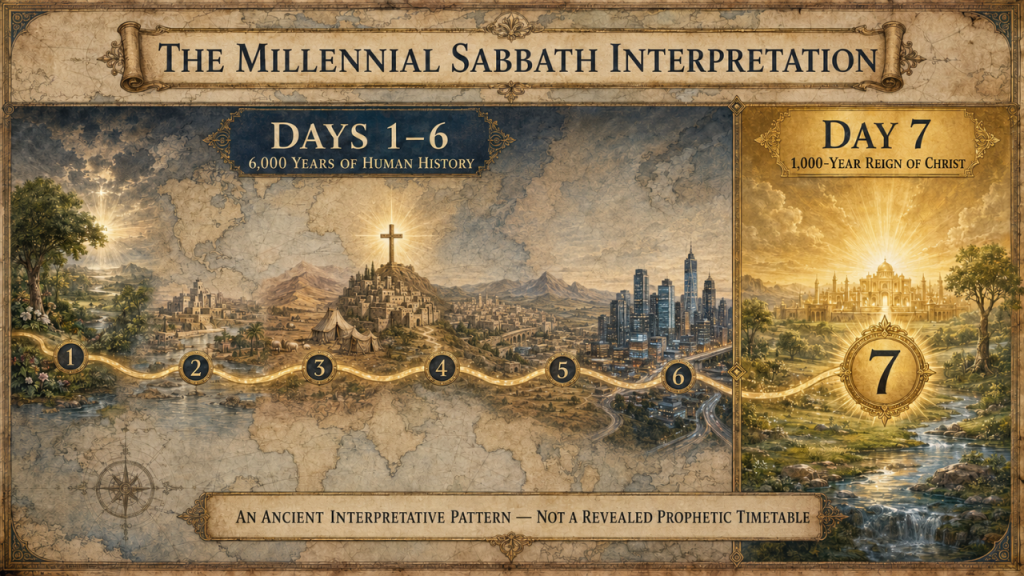
But could the opening chapter of Genesis contain another pattern? Could the seven days of creation provide a picture of the broad course of human history, six thousand years of labour and sorrow followed by a thousand-year reign of Christ?
If this pattern reflects God’s design, it raises a remarkable possibility: could we now be approaching the close of the sixth “day” of human history?
This interpretation may be unfamiliar to many Christians. Yet it is not a recent idea invented by modern prophecy teachers. It appears in some of the earliest Christian writings outside the New Testament and was later taught by several influential figures in the early Church nearly 2,000 years ago.
That does not necessarily mean the interpretation is correct. The fact that the teaching is old does not give it the authority of Scripture, and the Bible never explicitly tells us that the creation week is a prophetic timetable. Nevertheless, the idea has deep historical roots and raises a question worthy of careful consideration.
The Pattern Begins in Genesis
Genesis tells us that God created the heavens and the earth in six days. On the seventh day, He rested from His work.
This forces us to ask why.
God did not need six days to create the universe. He could have brought everything into existence in an instant. The deliberate pattern of six days followed by a seventh day of rest therefore invites us to consider why He chose to order His creative work in this way.
“on the seventh day God completed His work which He had done, and He rested on the seventh day from all His work which He had done.3 Then God blessed the seventh day and sanctified it, because on it He rested from all His work which God had created in making it.” (Gen. 2:2–3).
The first six days were marked by creative activity. The seventh was different. God ceased from His work, blessed the day and set it apart as holy.
This pattern became the foundation of Israel’s Sabbath: six days of labour followed by a seventh day of rest. Yet the New Testament shows us that God’s rest carries a significance greater than the weekly Sabbath alone.
Hebrews 4 looks back to the seventh day of creation and speaks of a rest that still remains for the people of God. The writer declares:
“So there remains a Sabbath rest for the people of God” (Heb. 4:9).
The immediate emphasis is upon entering God’s rest through faith and persevering in that faith. The passage by itself does not say that this Sabbath rest is a future thousand-year kingdom. Even so, it shows that the seventh day possesses a continuing theological significance. God’s rest in Genesis points beyond itself.
The question is how far that pattern should be taken.
Is One Day Equal to a Thousand Years?
Two passages are regularly mentioned in connection with this interpretation.
Moses writes:
“For a thousand years in Your sight are like yesterday when it passes by, or as a watch in the night” (Ps. 90:4).
The Apostle Peter expresses a similar truth:
“But do not let this one fact escape your notice, beloved, that with the Lord one day is like a thousand years, and a thousand years like one day” (2 Pet. 3:8).
Neither passage gives us a formula for calculating prophetic chronology. Psalm 90 contrasts the eternity of God with the frailty and brevity of human life. Peter is reassuring believers who are troubled by the apparent delay of Christ’s return. God has not forgotten His promise, nor is He slow to fulfil it. He does not experience the passing of time as we do.
We must therefore be careful. Peter does not tell us that every day mentioned in prophecy represents exactly one thousand years. In fact, his comparison works in both directions: one day is like a thousand years, and a thousand years are like one day.
Nevertheless, these passages supplied early Christian writers with the language through which they understood the creation week as a broad pattern of history. Six days were seen as corresponding to six thousand years, while the seventh day anticipated a final period of rest.
This was not a calculation drawn from one isolated verse. It was an interpretation built from the relationship between creation, Sabbath rest and the promised reign of Christ.
The Seventh Day and the Reign of Christ
Revelation 20 describes a period of one thousand years during which Satan is bound and Christ reigns with His people.
Christians do not all understand this passage in the same way. Amillennial believers generally interpret the thousand years symbolically and associate them with the present Church Age. Premillennial believers understand the passage as describing a future reign of Christ upon the earth.
For those who hold the premillennial view, the proposed pattern is readily apparent. Six days of creation correspond to approximately six thousand years of human history. The seventh day of rest then foreshadows the thousand-year reign of Christ—the great Sabbath rest of the earth.
Human history since the Fall has been characterised by toil, suffering, conflict and death. The future kingdom will be marked by the righteous rule of Christ, the restraint of Satan, justice among the nations and the fulfilment of God’s promises.
This correspondence is attractive, but we should describe it accurately. It is an inference drawn from several passages, not a doctrine plainly stated in a single text. Our confidence must never go beyond what God has revealed.
An Interpretation Found Among Early Christians
One reason this view deserves attention is its antiquity.
The anonymous Epistle of Barnabas, generally dated to the late first or early second century, although its precise date remains disputed, gives an explicit interpretation of the creation week:
“Therefore, my children, in six days, that is, in six thousand years, all things will be finished” (Epistle of Barnabas, 15).
The writer then connects the seventh day with the coming of the Son, the judgement of the ungodly and God’s final rest.
Around AD 180, Irenaeus expressed the same basic understanding:
“For in as many days as this world was made, in so many thousand years shall it be concluded” (Against Heresies, 5.28.3).
Irenaeus recalled hearing Polycarp when he was young, and Polycarp was traditionally associated with the Apostle John. That historical proximity is noteworthy. It shows us that this understanding is not a modern idea, but it does not conclusively prove that the interpretation came from John or any other apostle.
Similar ideas later appeared in the writings of Hippolytus and Lactantius. This shows that the six-thousand-year pattern was known among several influential early Christian writers. It was not created by dispensationalism, modern prophecy conferences or recent debates about the age of the earth.
At the same time, antiquity is not authority. The early Church Fathers could be mistaken, and they frequently disagreed with one another. Their testimony helps us understand the history of an interpretation, but only Scripture can determine whether a doctrine is true.
A Similar Pattern in Rabbinic Tradition
A comparable idea also appears in rabbinic Jewish tradition.
The Babylonian Talmud records the teaching that the world would continue for six thousand years and enter a seventh thousand-year period of desolation. Another tradition divides the six thousand years into three periods: two thousand years of chaos, two thousand years of Torah and two thousand years associated with the coming of the Messiah (Sanhedrin 97a).
This is not the same as the Christian doctrine of Christ’s millennial reign. Nor can the surviving form of the Talmud prove that the tradition arose before its earliest Christian expressions. It does show, however, that Jewish teachers also connected the days of creation with a wider chronology of the world.
Why Is the Interpretation Rarely Heard Today?
Many Christians in the early centuries expected a future earthly reign of Christ. As time passed, however, non-literal interpretations of Revelation 20 became increasingly influential.
Augustine played a particularly important part in that change. He had once accepted a form of future millennial expectation, but later understood the thousand years as representing the present reign of the saints during the Church Age (The City of God, 20.7).
His interpretation exercised enormous influence upon Western Christianity. As the future earthly Millennium disappeared from the theology of much of the Church, the proposed connection between the seventh creation day and Christ’s thousand-year reign also became less prominent.
This does not mean that Augustine alone caused the interpretation to vanish, nor that every Christian before him held a premillennial position. Church history is rarely that simple. It does help to explain why an idea found in several early Christian writings is seldom discussed in many churches today.
Does the Pattern Require a Young Earth?
Those who accept the six-thousand-year interpretation usually understand the genealogies of Genesis as indicating that humanity has existed for approximately six thousand years. Many also believe that the earth itself is of a similar age.
One argument sometimes offered is that God created a mature world. Adam was only moments old when God breathed life into him, yet he was not an infant. He could walk, speak, work and enjoy fellowship with his Creator. The trees already bore fruit, and the animals were capable of carrying out the purposes for which God had made them.
Are We Near the End of the Sixth Day?
If the six-thousand-year pattern reflects God’s design, it naturally raises another question: could human history now be approaching the close of its sixth “day”?
The honest answer is that it may be possible, but we simply do not know.
Biblical chronologies are debated. Different manuscript traditions contain differences that affect calculations, and sincere Christians have reached different conclusions about the age of humanity. Attempts to identify the exact year of Christ’s return have repeatedly ended in embarrassment and disappointment.
Jesus did not command His disciples to calculate the date. He commanded them to be ready.
The possible pattern should therefore lead us to watchfulness, not speculation. If an interpretation produces confident predictions that Scripture does not permit, it has been taken too far. God has revealed enough to give us hope and to call us to faithfulness. He has not revealed enough to satisfy every curiosity.
A Pattern Worth Considering
Whether or not the creation week was intended to provide a chronology of human history, it directs our attention towards a truth that runs through the whole Bible.
History is not random. The world is not moving without purpose towards an unknown end. The God who decreed the end from the beginning is bringing all things towards the conclusion He has appointed.
From the opening chapters of Genesis to the closing chapters of Revelation, one plan unfolds. It is centred upon Jesus Christ.
If the seventh creation day foreshadows the millennial reign of Christ, then a great Sabbath rest still lies ahead. Satan will be restrained, righteousness will characterise Christ’s kingdom, and the King will reign openly upon the earth.
If the pattern is best understood as an illustration rather than a precise prophetic timetable, it still points us towards the same hope. Christ will return. Evil will not triumph. God’s purposes will not fail.
Our calling is not to calculate a year that God has chosen not to reveal. It is to belong to Christ, to remain faithful to Him and to live each day in joyful expectation of His appearing.
The question is not whether we can work out exactly when He will come.
The question is whether we are ready.
Has this article encouraged or helped you?
Exposit the Word is a reader-supported ministry dedicated to proclaiming God’s Word faithfully and freely. If you have been blessed by this ministry and would like to help us continue producing biblical resources, please consider supporting us here.